
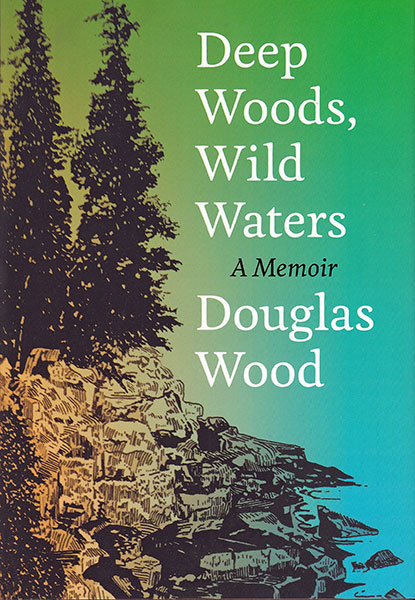
Review by Steve Voiles
In his memoir, Deep Woods, Wild Waters, Doug Wood tells us, wind, water, wild creatures, and weather can shape us into better people. “…The universe itself becomes more accessible. Awareness expands.” We pay attention; we end up seeking “the moment when the connection is complete.” Since we came from nature, we must be deeply connected to it.
Deep Woods, Wild Waters may be the year’s best read for lovers of the North Woods. Written by Douglas Wood, the president of the Listening Point Foundation, the book condenses a lifetime of thinking about the importance of nature and wilderness and its influence upon the human spirit.
“Birds, fish, wildlife, the flowing of water and the movement of clouds, the rise and fall of landscape, all these elements reflect and mirror the landscape within, and help to bring it into focus.” It is this ability to relate the outer world of nature to the inner world of meaning that elevates Wood’s work above other nature writers who may amaze or entertain us, but who often fail to touch our inner personal lives.
Wood, who suffered with ADHD and dyslexia as a child, defied all odds by becoming a best-selling author, singer/song writer and a wilderness guide. As a child, Wood had found solace in the fields and forests. When fishing with his grandfather or exploring the fields or forests, he escaped the pain and frustrations of school.
During the struggles of his early adult life, Wood’s wife Kathy suggested he read Listening Point by Sigurd Olson because of his love for natural things. Wood was shaken to the core by Olson’s writing. “Here was someone who saw the world as I did!” he recalled. Wood wrote to Olson to thank him for his writing, and Olson, who had also struggled in his early life, responded immediately commenting on the quality of Wood’s writing and encouraging him to pursue it. This encouragement became central to all that followed.
While Wood’s memoir naturally reflects the values and sentiments that are reflected in Olson’s work, Deep Woods, Wild Waters claims its own literary style and establishes Wood as a nature writer in his own right.
The book traces Wood’s childhood influences through his life as a musician, a children’s writer and a wilderness canoe guide. Following the muse of the natural world, he confronted each key decision in his life by opting for choices that kept him connected to the wild lands that nurtured his spirit. Wood’s writing always strives to find the connection, learn the lesson, grasp the deeper meaning of what nature reveals. “The vast rhythms and tempos of the natural world—sunrises and sunsets, the songs of wind and the crashing of storm waves. All the pregnant smells, sights, and sounds to which we are so often closed… Each is a language, each an instruction … biologically rooted in the heritage of the earth.”
Testing ourselves against water, wind and weather, Wood writes, prepares us for other challenges in life. “The worry over challenges to come is almost always worse, and lasts far longer, than the actual difficulty itself,” he writes. “Without fear, and the overcoming of fear, there is no adventure. And without adventure, life is a very weak brew.”
His description of a wildflower, the Pale Pink Corydalis, encapsulates many of the ideas that permeate the book:
“Here, on the exposed bedrock, with little to no soil, baking in the summer sun, absorbing the gray-fisted blows of howling nor’easters with their shredding winds, vulnerable to the inundation of winter snows and the unseen, rock-breaking assaults of frost, thawing, and refreezing … This is where it grows. This is where it stands and flaunts its little flag of color. To everything it is exposed, to every element, in every season. With only the tiniest of cracks and footholds to cling to, it stands. Delicate. Vulnerable. Tough. Defiant. Beautiful. And, brilliantly, it holds to all these charms at once. And therefore. it is, to me, inspirational, and a messenger to the heart.”
Wood’s writing quite naturally extends an environmental message. “We all live downstream,” he tells us; “…everything that anyone does—be it laundry or mining or logging or driving a car or riding a bus or flipping a light switch or purchasing a product—has an effect on someone else downstream. …Our only excuse for not knowing such things now is not wanting to know—the excuse of cowardice, of willful ignorance—which is, of course, no excuse at all. …It is our task to engage not just in the work of preservation, but of restoration.”
This is a book that cannot help but cause us to reflect upon what is significant in our own lives. In a culminating chapter, “The Stars of Sandfly,” Wood explores the existential challenge of finding meaning in life. “I felt keenly two separate feelings. One was the sense of being at home, alive and well upon the Earth, my favorite part of the Earth, in a place of extraordinary beauty. The second feeling was nearly the opposite—as if I were at the very edge of being lost—totally lost—in a universe vast beyond imagining, terrifying and impersonal in its scope and in all the unknowns it represented.” With a flair for unwrapping paradox he managed to connect the deep cold silence of the universe with the intimacy of private perception and creativity.
We spring from nature; we must be connected to it. By fully encountering nature, Woods tells us, we are “… seeking the moment when the connection is complete.” It is what we all search for he reminds us, and loving and protecting the natural world is the path towards significance in our individual lives. “We grow only if we accept the reality of distant thunder, and all of the fear and adventure it portends.”
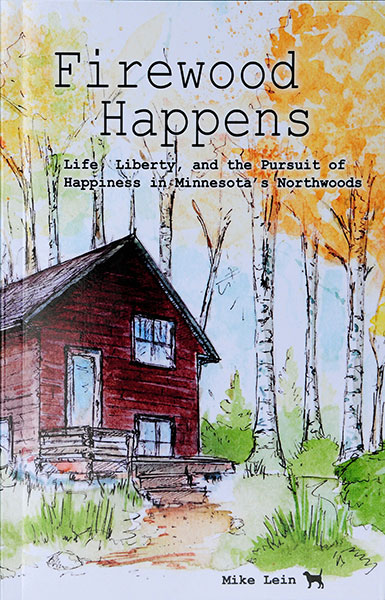
A series of short essays, humorous, knowledgeable stories for those who like to hunt, fish, or sit on a lakeshore.

Three-finger handle with logos, one side has web site address and the other says “Sig’s legacy…pass it on!” Available in black with white lettering or white with black lettering.
NEW! Waxed Waterproof LPF Journal
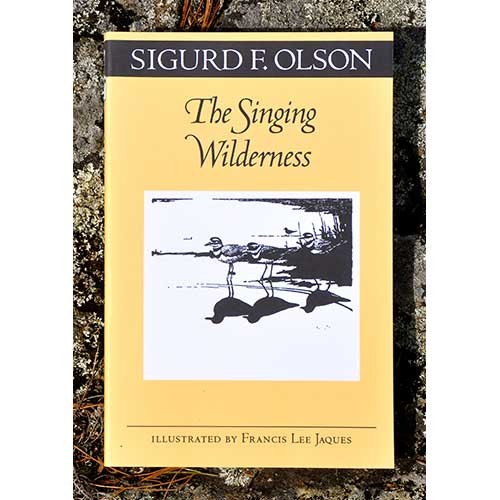
The Singing Wilderness is Sigurd Olson’s first, and perhaps best, book. For 30 years Sigurd had been writing reflective essays about his experiences in the wilderness and trying unsuccessfully to publish them. When Albert Knopf offered him a book deal, it didn’t take him long to put together his best writings. Essays such as “No Place Between” or “The Loons of Lac La Croix” narrate short trips where the author’s exuberance practically jumps off the page, while “The Way of the Canoe” and “Silence” establish wilderness as a vital connection to our past. The Singing Wilderness is Sigurd’s most energetic and poetic book, establishing him among America’s best outdoor writers.
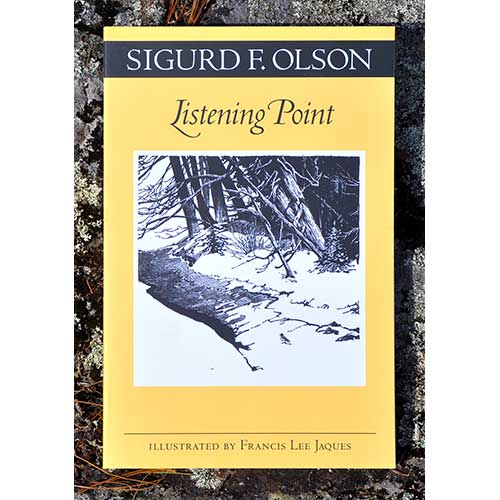
Listening Point is titled after Sigurd Olson’s retreat on Burntside lake near Ely, Minnesota. Sigurd Olson considered Listening Point more than just a piece of land; it was a “composite picture” of the northern wilderness he knew and loved. As he built a road and moved a cabin to the point, though, he faced a problem that our generation continues to struggle with: How do we simultaneously access and preserve wilderness? Listening Point is an eloquent exposition of the dilemma from one of America’s most poetic conservationists; it is philosophy grounded in the richness of Sigurd’s everyday experiences at Listening Point. Published in 1958.
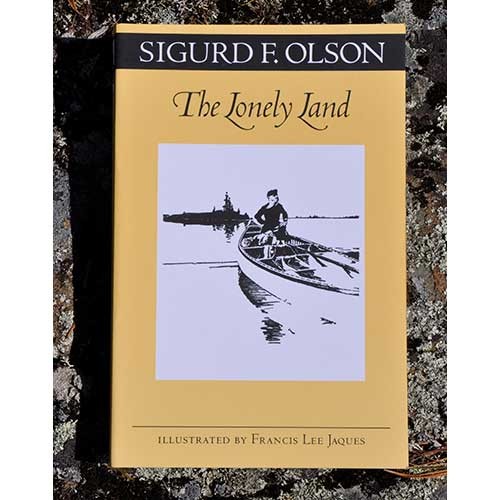
This book chronicles Sigurd Olson’s canoe trip on the Churchill River in the Canadian wilderness with a group of friends. It is an interesting travel account and describes the growing friendship, forged in the wilderness, between Sig, the Bourgeois, and his friends, the Voyageurs. But The Lonely Land is much more: It is full of reflections on what we’ve lost as a people since the day we lived among what Sigurd calls the “great silences.” Published in 1961.
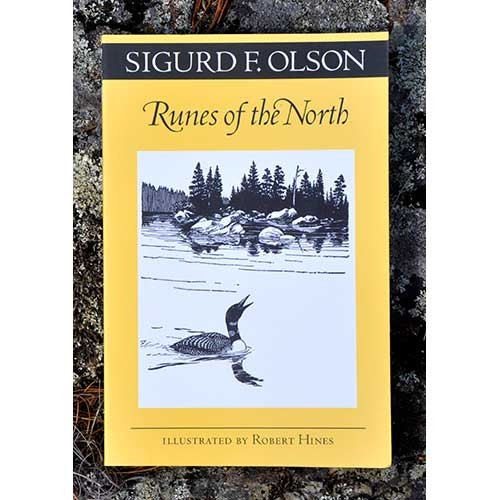
This book is a collection of essays that go beyond good outdoor nature writing and venture more clearly into philosophy. Sigurd Olson’s earlier books had evoked a conservation ethic and pointed to a wilderness philosophy that is more consciously developed in Runes of the North. The title, and even the choice of topics, such as “The Dream Net,” “The Sauna” and “Wild Rice,“ suggest a search for meaning in ancient traditions, but Runes of the North is also a song of praise for what the Voyageurs called Le Beau Pays, The Beautiful Land. Published in 1963.
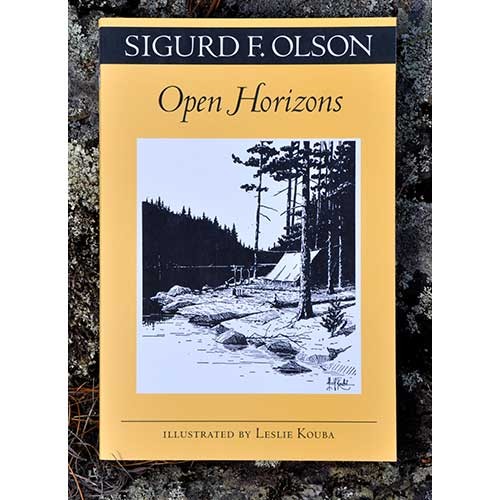
Open Horizons tells the story of Sigurd Olson’s life, from his childhood to his discovery and exploration of the Quetico-Superior country near Ely. The later chapters become increasingly philosophical, as he offers reflections on his work as a conservationist and environmentalist and wonders about the future of wilderness.
It sets the tone for Sigurd Olson’s biography in the essay, “The Pipes of Pan.” Some of his earliest memories are being enthralled by small, wild places and experiences that would shape his life and writings. As an adult he continued to listen for the loons, wolves, the singing wilderness and the voices of the voyageurs. Published in 1969.
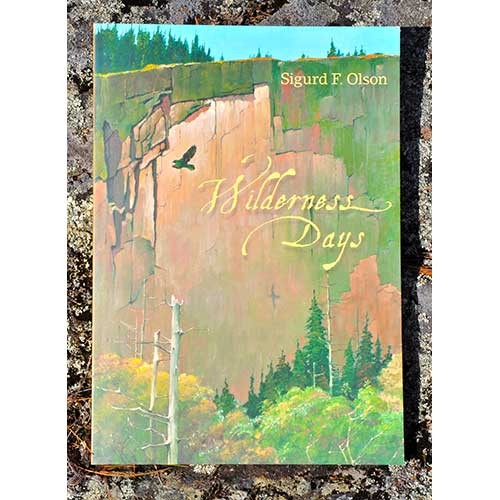
University Press has published a NEW paperback edition of Wilderness Days, a collection of Sig Olson’s writings that depicts the essence of the magnificent woodlands and waters of the legendary Quetico-Superior region that borders Minnesota and Ontario.
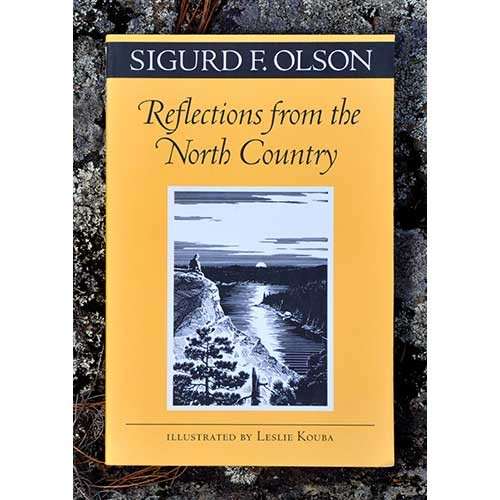
Sigurd Olson establishes himself among Thoreau and Emerson as one of America’s great philosophers. His earlier books were full of wilderness experiences and reflections that had clear philosophical implications, but in this book, the last published in his lifetime, Sigurd concentrates on the philosophy of wilderness. “It is more than wilderness, beauty, or piece of mind; it is the survival of man and his culture.” Reflections from the North Country is a reflection on Sigurd’s own experiences and ideas, but is also a response to the many philosophers and theologians that he had read, ending with a hopeful discussion of an “emergent God.” Published in 1976.
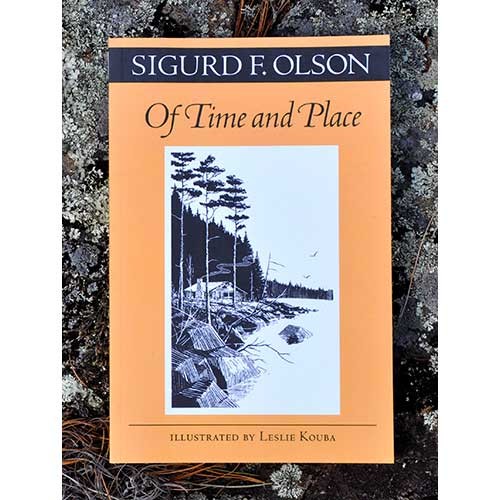
Sigurd Olson finished writing this book shortly before he died and it was published posthumously. It is a wistful book, a look back at a “lifetime of searching for meaning.”
One chapter in particular, “Momentos,” describes various articles in his cabin and what memories they hold for him. Of Time and Place ends, appropriately, with Sigurd’s reflections while watching the sunset from Listening Point. Published in 1982.
A digitally remastered version of the classic film “The Wilderness World of Sigurd F. Olson” includes more than two hours of conversations with Sig as he speaks about the craft of writing and life in the wilderness. You’ll also hear Sig’s wife Elizabeth and their son Sig Jr. speak candidly about Sigurd, his profession, and life in the north woods.
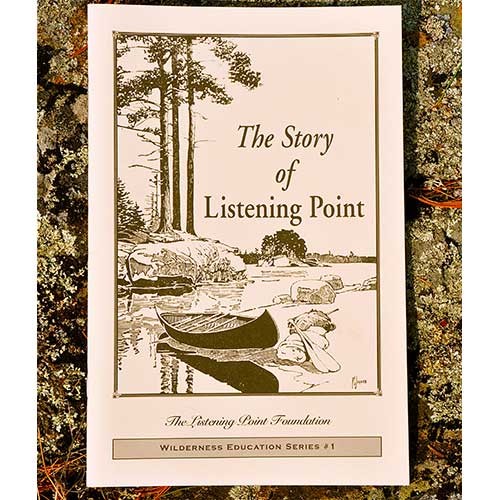
This 28-page booklet, written by Sig’s son Robert K. Olson, tells the inside story of how Listening Point came to be and why, what it meant to Sigurd Olson, and what it continues to mean to wilderness lovers and loyalists. Features dozens of historical photos and images.
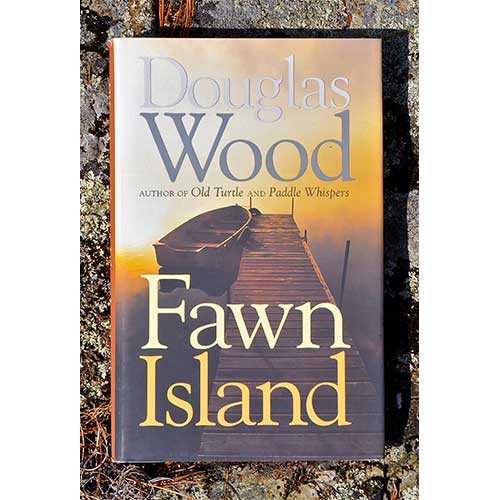
Fawn Island is not merely a charming wilderness hideaway; it is the entry to realms of thought and meaning as well. Author Doug Wood probes for meaning into the nature of neighborliness and independence, of community and solitude. Hard cover.

Show your support for Listening Point and look stylish at the same time in your 100% cotton cap embroidered with the Listening Point logo. Choose from Spruce Green, Aqua, Caribbean Blue, Ivory, Poppy, and Khaki/Spruce Green (two-toned). Availability may vary. Adjustable leather strap.
Pictured left to right: Aqua, Khaki/Spruce Green (two-toned), Poppy, Spruce Green, Caribbean Blue, and Ivory.